Skip to content
Dana ReidThe Shelf Ledger

Private-label specifications · outside Grand Rapids

Pay for what is in the package, not the costume

I wrote private-label specifications outside Grand Rapids, where the plant filled a national brand on Tuesday and a store brand on Wednesday from the same tank. Turn the package around: read the plant code, net quantity, ingredients, dates, directions, and unit price before the front label decides for you.

Review delivery and refund terms at checkout.

Turn It Around

PDF e-book · 207 pages

PDF e-book · 207 pagesDana Reid · private-label specifications outside Grand RapidsLook inside ↓

The books

Turn It Around

Turn It Around

The books / 01

Turn It Around

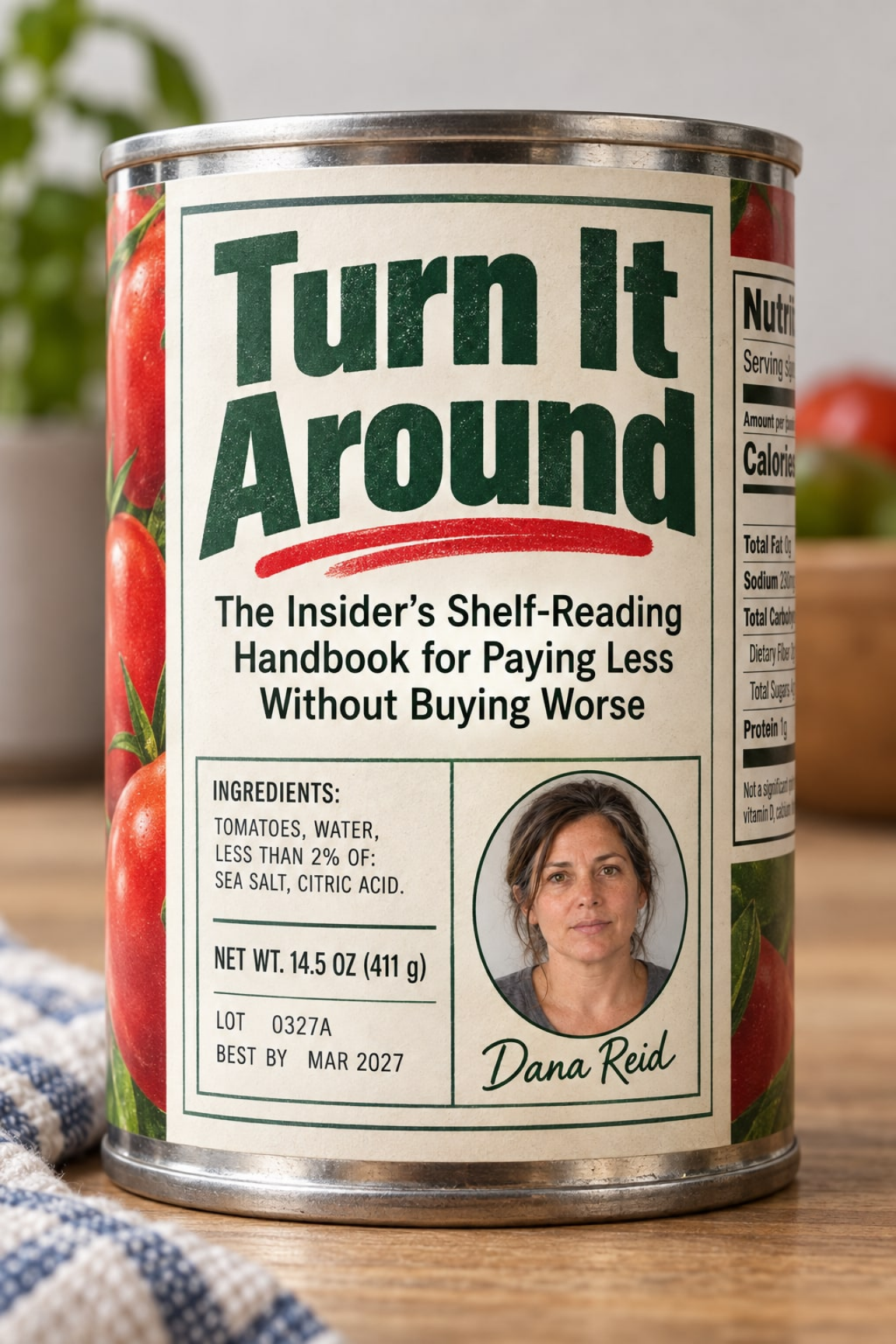
The Insider’s Shelf-Reading Handbook for Paying Less Without Buying Worse

A matching plant code can show shared manufacturing at one site, but it does not prove identical formula, fill, packaging, or performance.

Turn It Around is a shelf-reading handbook for the shopper who wants to compare the thing inside the package, not just the name on the front. I begin with The Paper Behind the Package: brand owner, plant, formula, tolerances, code marks, and the difference between shared manufacturing and identical product. From Unit Price Without a Calculator and The Weight You Can Actually Use, I move through shrinkflation, canned foods, dairy, meat, frozen food, laundry, paper goods, cleaners, and personal care. You get worked arithmetic for usable ounces, drained weight, cooked yield, cost per load, paid water, and price memory, plus a four-week plan for changing one aisle at a time.

Selected chapters

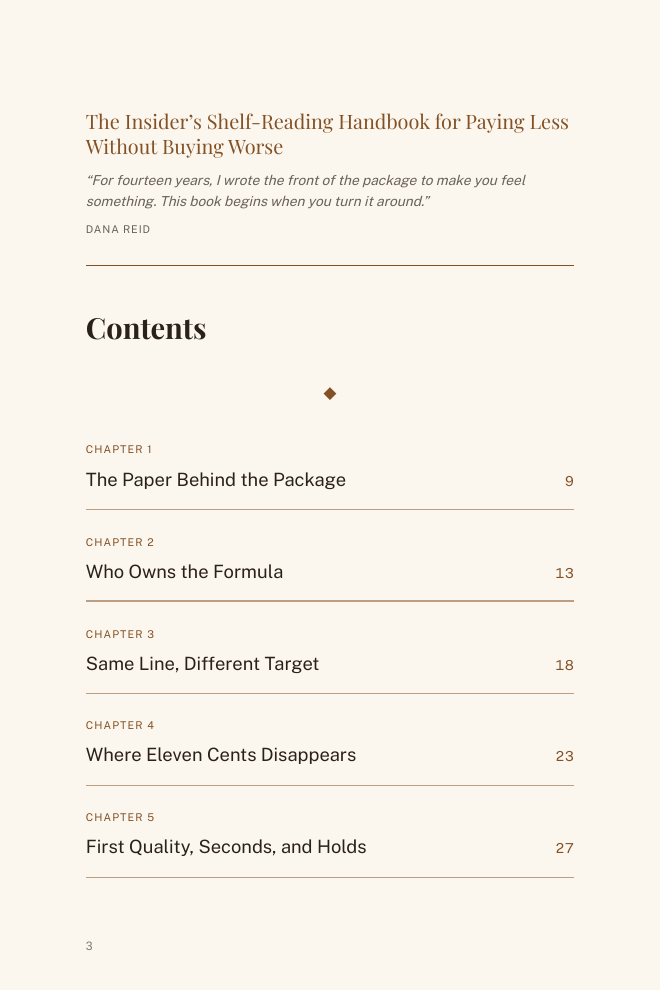
  1. The Paper Behind the Package
  2. Who Owns the Formula
  3. Same Line, Different Target
  4. Where Eleven Cents Disappears
  5. First Quality, Seconds, and Holds
  6. Unit Price Without a Calculator
  7. The Weight You Can Actually Use
  8. Ingredient Order Is a Map

The Shelf Ledger

When the shelf price is not the whole price

A familiar package can change quietly: its count, fill, formula, dose, or usable yield may move while the front panel stays familiar. These are the moments when a quick, repeatable shelf check earns its place.

  • Two bottles carry the same small plant code, and you cannot tell whether the match means the same formula, the same fill, or only the same building.
  • A 16-ounce package becomes 14 ounces while the shelf price holds, so your old unit-price memory no longer matches the amount in your hand.
  • A can lists net weight, but drained tuna, olives, or fruit leave a different amount for the recipe.
  • A detergent bottle lists a large load count, but dose size and concentration decide what each normal wash actually costs.

Selected chapters

Three useful ways into the book

You do not have to read every category at once. Start with the shelf decision in front of you, then use the matching chapter and keep the evidence you can check.

  1. Start with the paper behind the package

    Read The Paper Behind the Package and Who Owns the Formula before comparing brands. Turn bottles around for ingredients, net quantity, material, storage instructions, and plant or lot code; treat the code as a clue, not a verdict.

  2. Do the shelf arithmetic

    Use Unit Price Without a Calculator, The Weight You Can Actually Use, and Catch the Shrink Before Checkout. Compare price per usable ounce, drained ounce, load, sheet, or cooked serving, and record the exact package size.

  3. Work one aisle at a time

    Choose one aisle—canned pantry goods, dairy, meat, frozen food, or non-food—and follow its category checks. Then use Build a Price Memory on Paper and Four Weeks to a Smarter Cart to record sale cycles and set a stock-up threshold.

Look inside

Open the package from the back

Open a page and read it. The opening chapter puts the specification file before the front label, then follows the people who write, review, approve, and release it. You will meet the Tuesday national-brand and Wednesday store-brand example, the matching plant code, and the caution that shared manufacturing does not prove identical formulas. Later chapters carry the same method into unit prices, drained weight, shrinkflation, food categories, laundry, cleaners, paper goods, and personal care.

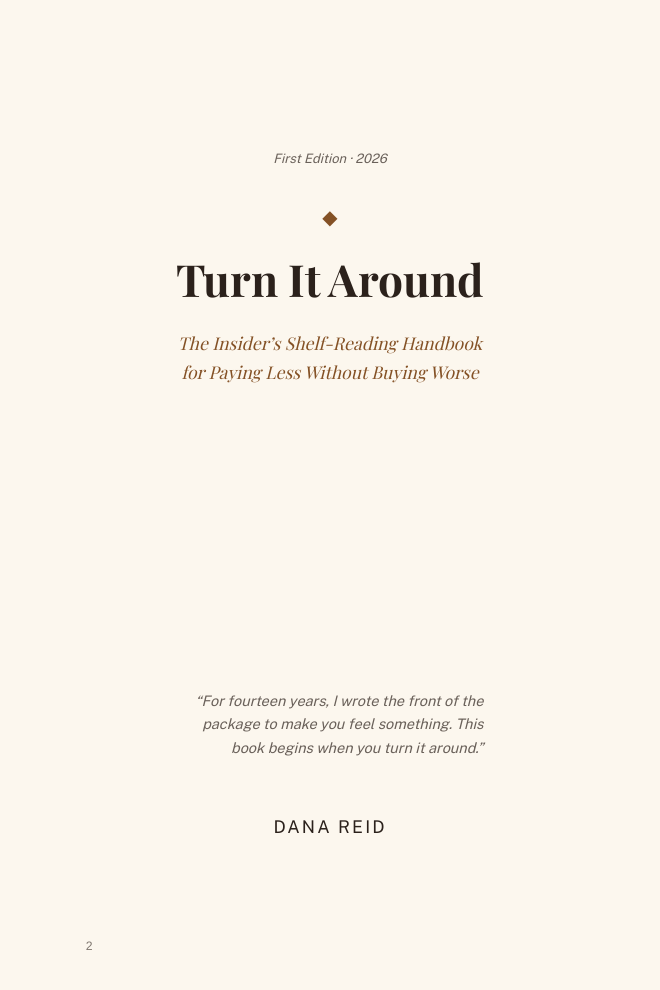
Open sample page 1
Open sample page 01 ↗
Open sample page 2
Open sample page 02 ↗
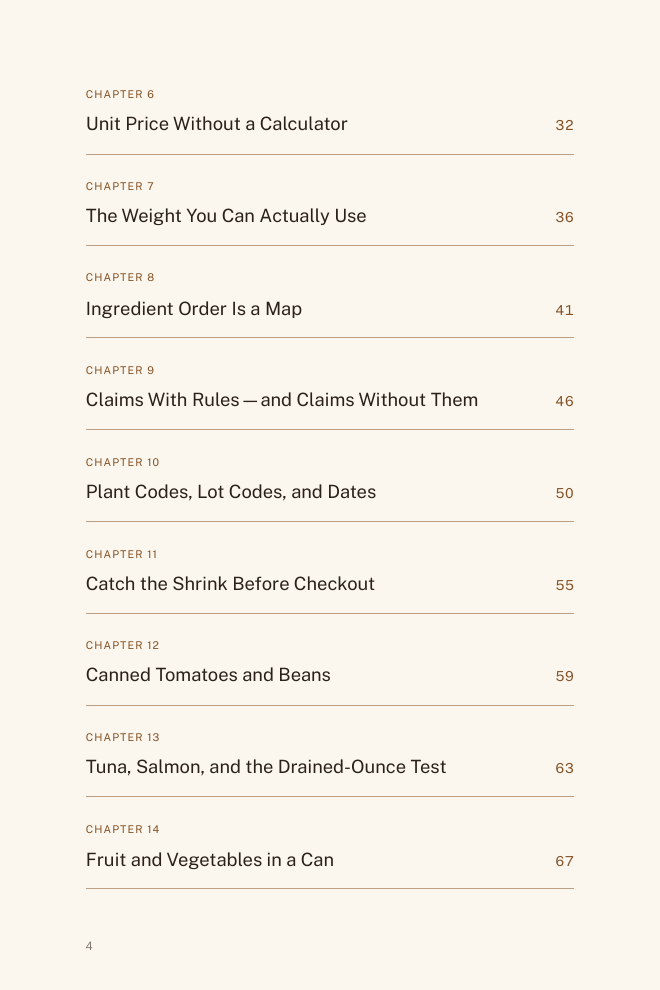
Open sample page 3
Open sample page 03 ↗
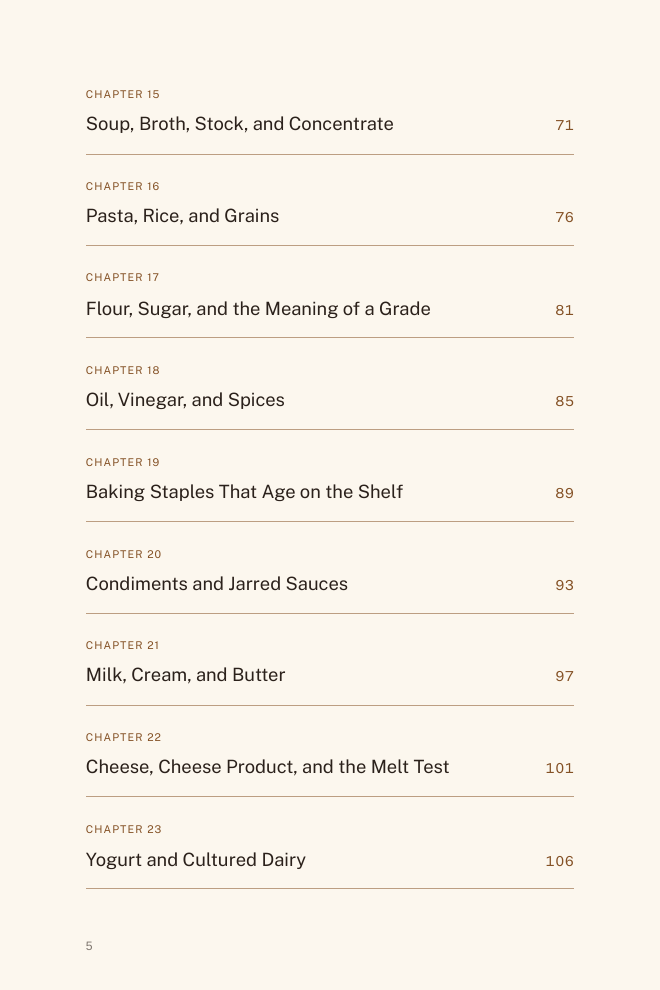
Open sample page 4
Open sample page 04 ↗
Dana Reid

From the author

A specification writer who still turns packages around

I am Dana Reid. From 2009 to 2023, I wrote private-label specifications for a contract manufacturer outside Grand Rapids—the plant that filled a national brand on Tuesday and a store brand on Wednesday from the same tank. I signed both sets of paperwork. Roz Kaminski, the QA lead who trained me, taught me to respect revision numbers, tolerances, test methods, and released copies. My mother, Joan, spent nineteen years at a Meijer register and taught me to judge a package by what it does in the cart, kitchen, and refrigerator.

Plant floors took most of the hearing in my right ear, and I still turn packages around. For fourteen years I was the person who was not going to tell you—I wrote the language on the front of that package and know exactly what it was designed to make you feel. This book puts the paper, arithmetic, and practical limits back in your hands. I will tell you what a clue proves, what it does not, and when a premium is worth using.

— Dana Reid

This is for you if

Who I wrote this for

This is for you if

  • You shop for food, cleaning supplies, paper goods, or household basics and want to compare what you can actually use.
  • You are willing to turn a bottle, carton, or bag around and record net quantity, code, dose, or unit price.
  • You want a paper method for noticing shrinkflation and store sale cycles without relying on a vague memory.

A different starting point if

  • You need a personal medical decision settled at the shelf; the OTC chapter names active ingredients and directs individual questions to a pharmacist or clinician.
  • You want a universal verdict that store brand always matches national brand; this book keeps the distinctions and uncertainty.

What you get

The complete book, in PDF

Your order includes Turn It Around as a 207-page PDF e-book. It moves from specification files and package codes to unit price, drained weight, shrinkflation, food and household categories, and a four-week price notebook. Open a page and decide whether this is the shelf-reading method you want.

Turn It Around

Your order

The Shelf Ledger

$19

PDF e-book · 207 pages

  • Turn It Around · 207 · PDF
Get the book $19

Review delivery and refund terms at checkout.

The Shelf Ledger

Questions

Do I need experience with food manufacturing to use this book?

No. I start with the specification file and explain brand owner, plant, formula, tolerances, and codes in plain shelf terms, then apply them to ordinary package checks and arithmetic.

Which parts of the store does it cover?

It covers pantry staples, dairy, eggs, deli and bakery, meat, fish, frozen foods, laundry, cleaners, paper goods, bags and wrap, personal care and OTC basics, batteries, bulbs, cookware, and small appliances.

What does a matching plant code actually tell me?

A matching small code on two brands can show shared manufacturing at that site, but it does not by itself prove identical formula, fill, packaging, or performance. Code structures vary by manufacturer, so use the mark with the rest of the package evidence.

What calculations will I use?

The book teaches mental unit-price checks and comparisons by usable ounce, drained ounce, prepared cup, cooked serving, cooked pound, normal laundry load, square feet, and the water you pay for in enhanced meat. The examples also cover fill, count, dose, and package size.

Does the book say store brand is always the better buy?

No. A store brand may be a close match, a different formula, or a cheaper package around a similar formula. The method is to pay for differences your household will actually use, not to choose a label automatically.

What format and length is included?

Turn It Around is a PDF e-book, 207 pages.

Does the personal-care and OTC coverage replace professional advice?

No. The personal-care and OTC chapter compares active ingredient, strength, dosage form, package count, and directions. When a choice calls for individual guidance, I point readers to a pharmacist or clinician instead of treating shelf arithmetic as the answer.

Where can I review delivery and refund terms?

Review delivery and refund terms at checkout. Those checkout terms govern the order.

Turn the package around

I wrote this so you can read ingredients, quantity, code, and directions before the front label sets the mood. Pay only for differences your household will use; open the book when you are ready.

Get the book $19

Review delivery and refund terms at checkout.